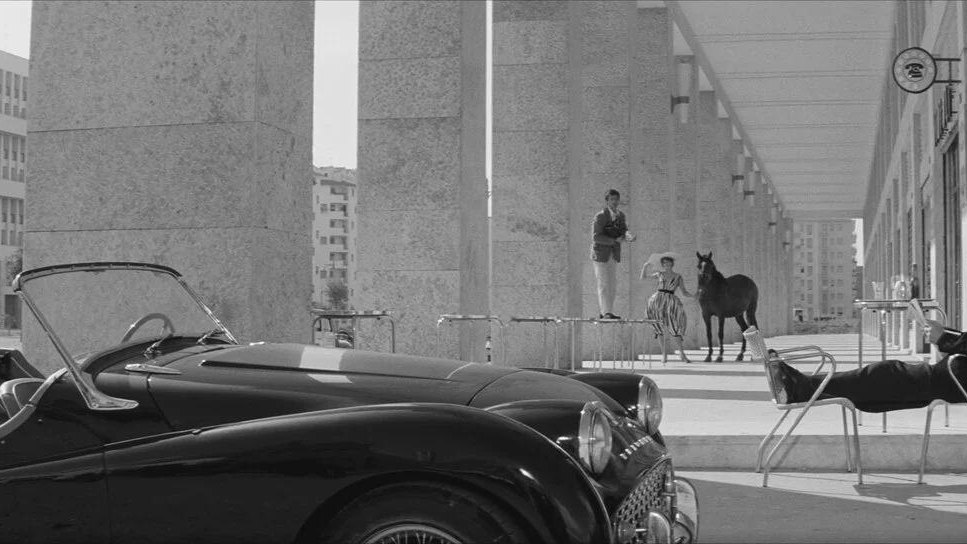
No country has been filmed more lovingly or more often than Italy, and the best films set there use the country the way the best novels do — not as backdrop but as argument. The light, the ruins, the food, the particular Italian relationship between beauty and corruption and history — all of it presses into the frame. These nine films span seventy years of cinema and four distinct Italys: Fellini’s Roman excess, Guadagnino’s northern summer, Minghella’s sun-drenched south, Zeffirelli’s medieval Verona. All of them will make you want to go.
Tom Ripley is sent to Italy to bring back a wealthy man's son and decides instead to become him. Minghella's adaptation of Patricia Highsmith's novel is ravishing and deeply sinister — a film about desire and class and identity set against the Amalfi Coast, Venice, and Rome at their most intoxicating. Matt Damon plays Ripley as a man who wants so badly to be someone else that he becomes genuinely dangerous. Jude Law has never been more beautiful or more carelessly cruel. The Italy it depicts is the Italy of postcards — which is exactly why Ripley wants it so badly.
Find on Amazon →The summer of 1983, somewhere in northern Italy. Elio, seventeen, spends six weeks falling in love with Oliver, his father's graduate student. Guadagnino's film is one of the great sensory experiences in recent cinema — the heat, the peaches, the music, the particular quality of late afternoon light — and Timothée Chalamet's performance is one of the decade's finest. The final scene, Elio alone by the fire as the credits roll, is among the most devastating endings in modern film. André Aciman's source novel is equally worth reading.
Find on Amazon →A gossip journalist drifts through Rome's celebrity world over the course of a week — parties, scandals, a miracle, a movie star, a philosopher, an orgy — searching for meaning and not finding it. Fellini's three-hour masterpiece invented the paparazzi, gave the language the word "paparazzo," and created the template for every film about the emptiness of glamour that came after. The opening shot — a helicopter carrying a statue of Christ over the Eternal City — remains one of cinema's great images. Marcello Mastroianni has never been more perfectly cast.
Find on Amazon →A film director, stuck and exhausted, retreats to a spa town and tries to make sense of his life, his memories, his women, and the film he can't seem to make. Fellini's most personal work is a film about creative block made by a man in the grip of creative block, and the fact that it exists at all is its own argument. It moves between memory, fantasy, and the present without warning, and it is funny and strange and melancholy in equal measure. The definitive Italian film and one of the ten greatest films ever made.
Find on Amazon →A European princess slips her handlers in Rome and spends a day with an American journalist who recognises her but doesn't say so. Wyler's film made Audrey Hepburn a star and gave the city its most enduring cinematic portrait — the Trevi Fountain, the Spanish Steps, the Mouth of Truth, all of it exactly as it appears in a thousand guidebooks because this film made them iconic. Gregory Peck is effortlessly charming. Hepburn won the Oscar. The ending is more honest than you expect from a 1953 Hollywood picture.
Find on Amazon →Lucy Honeychurch arrives in Florence with her fussy cousin and finds the room she requested — a room with a view — occupied by the Emersons, a father and son who are forthright and unconventional and entirely wrong by Edwardian standards. Ivory's adaptation of Forster's novel is warm, witty, and beautifully observed — the Florence sequences are among the most evocative ever put on screen — and Helena Bonham Carter plays Lucy's awakening with a precision that makes the comedy feel genuinely earned. A film that makes you want to book a flight immediately.
Find on Amazon →Four interlocking stories set in Rome — an opera director who discovers a singing undertaker, an architect revisiting his youth, a young couple whose honeymoon is disrupted, a nobody who wakes up famous. Allen's late-period Italian films are looser and warmer than his New York work, and this one is pure pleasure: funny, unpretentious, genuinely in love with the city. Roberto Benigni and Penélope Cruz are particularly good. Not Allen's most ambitious film, but possibly his most affectionate.
Find on Amazon →A badly burned man is tended by a nurse in an abandoned Italian monastery in the final months of the Second World War, and the film moves between his recovery and the desert romance — in North Africa, pre-war — that brought him there. Minghella's adaptation of Michael Ondaatje's novel won nine Academy Awards and earned every one: the cinematography, the score, the performances by Ralph Fiennes and Kristin Scott Thomas are all benchmark achievements. The Italy of the monastery — ruined, beautiful, holding its breath at the end of a long war — is unlike any other Italy in cinema.
Find on Amazon →The definitive screen version of Shakespeare's play, filmed entirely on location in Tuscany and the medieval hill town of Gubbio, with two actual teenagers — Olivia Hussey and Leonard Whiting — in the lead roles. Zeffirelli's film captures something no other adaptation has managed: the specific recklessness of very young love, the way it moves at a speed that adults have forgotten. The Tuscany it depicts — golden, warm, ancient — is one of cinema's great Italian landscapes. If you've only seen the Baz Luhrmann version, this is the one to see next.
Find on Amazon →