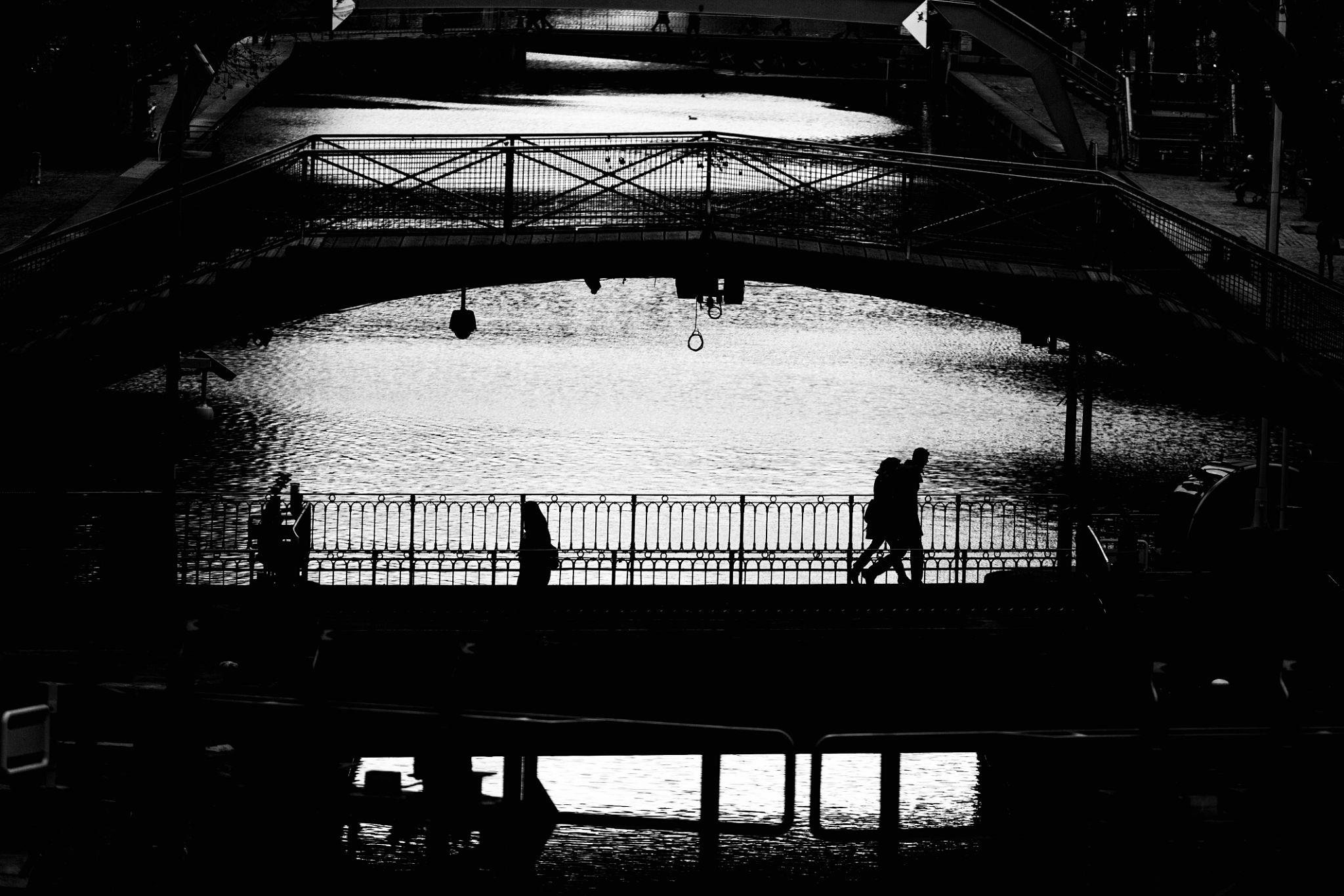
The tourist Paris and the Parisian Paris are not quite the same city. The tourist Paris has the Eiffel Tower, the Louvre, the overpriced café terraces near Notre-Dame. The Parisian Paris has jazz caves on the Left Bank, canal-side picnics with wine from the corner shop, flea markets that open at dawn, and a nine-kilometre elevated garden walk that most visitors have never heard of. This is a list of the second kind of Paris — the one that people who live here actually spend their time in. Specific addresses included throughout.
Paris has been one of the world's great jazz cities since American musicians came here in the 1920s and found an audience more receptive than the one they'd left behind, and the clubs that developed from that moment are still here. Le Caveau de la Huchette — a medieval cave beneath the Latin Quarter that has been running jazz and swing nights since 1946 — is the most historic: low ceilings, stone walls, a wooden dance floor that fills with actual dancers by midnight. Le Duc des Lombards in the 1st is the more serious jazz room, with better booking and a sound system that does justice to the musicians. New Morning in the 10th is where the bigger names play when they pass through Paris.
Go to: Le Caveau de la Huchette (5 rue de la Huchette, 5th) for atmosphere and dancing. Le Duc des Lombards (42 rue des Lombards, 1st) for serious jazz programming. Check listings at each venue — shows typically start at 9pm and run until 1am or later on weekends.
Paris Travel Guides on Amazon →The Canal Saint-Martin was built under Napoleon to supply fresh water to Paris, and the neighbourhood that grew up around it — the 10th arrondissement — has been the most consistently interesting part of the city for the past decade: independent bookshops, vinyl records, small restaurants, and the particular energy of a neighbourhood that hasn't quite been discovered yet while also being very much discovered. On warm afternoons, the canal banks fill with exactly the kind of scene you imagined Paris would be before you arrived: people sitting on the quais with wine and bread, feet dangling over the water, the iron footbridges and plane trees and iron lock gates composing a picture that the tourist centre stopped offering sometime in the 1990s.
Go to: The stretch between Rue du Faubourg du Temple and the Bassin de la Villette — pick up supplies at any of the small épiceries along the canal. For coffee before or after, Café Oberkampf on Rue Oberkampf is the neighbourhood benchmark. For dinner, the 10th has more good restaurants per block than almost anywhere else in Paris.
Paris Travel Guides on Amazon →The Parisian picnic is a social form as codified as any restaurant meal, and it has specific rules. You buy wine from a cave à vins, not a supermarket. You buy cheese from a fromagerie and bread from a boulangerie, not a convenience store. You arrive at the river with a blanket and sit on the stone quais below street level, where the city recedes and the water and the bridges and the occasional bateau mouche passing are all you can see. The Quai de la Tournelle on the Left Bank near Notre-Dame is the most beautiful spot. The Quai de Valmy along the Canal Saint-Martin is the most social. The Île Saint-Louis offers the feeling of being on a boat that never left.
Supplies: Fromagerie Laurent Dubois (97 rue Saint-Antoine, 4th) for cheese. Any of the dozens of boulangeries for bread — look for one with a queue. Cave des Abbesses (43 rue des Abbesses, 18th) if you're in Montmartre, or Nicolas which has locations throughout the city, for wine. A corkscrew. A blanket. More time than you think you need.
Paris Travel Guides on Amazon →Paris has three major flea markets, each with a distinct character. The Marché aux Puces de Saint-Ouen at Clignancourt — the largest antique market in the world, fifteen thousand square metres of dealers selling everything from Louis XVI armchairs to 1970s record players — is the grandest and most overwhelming. The Marché d'Aligre (see below) is the most local. The Marché de Vanves in the 14th, open on weekends from 7am until 1pm, is the most manageable and the best for genuine finds: smaller dealers, lower prices, and the specific pleasure of an early morning in a Paris that hasn't woken up yet.
Go to: Marché de Vanves (Avenue Marc Sangnier, 14th) for the most authentic experience — arrive by 8am for the best selection. Saint-Ouen (Metro Porte de Clignancourt) for sheer scale and serious antiques. Budget more time than you think you need at either.
Paris Travel Guides on Amazon →Built on top of a disused railway viaduct and opened in 1993 — fifteen years before New York's High Line, which was directly inspired by it — the Promenade Plantée runs for nearly five kilometres above the 12th arrondissement, from the Opéra Bastille to the Bois de Vincennes. Below the elevated section, the arches of the viaduct have been converted into the Viaduc des Arts, a series of workshops and galleries occupied by craftspeople: violin makers, furniture restorers, jewellers, fabric designers. Above, the garden path is planted with roses, bamboo, and cherry trees, and offers views over the rooftops of Paris that almost nobody on those rooftops knows exist. Consistently ranked by Parisians as one of the best things in the city. Consistently unknown to most visitors.
Go to: Enter at Avenue Daumesnil near Bastille and walk east toward Vincennes. The full walk takes about ninety minutes at a comfortable pace. The Viaduc des Arts below is worth a separate visit for the workshops alone — several of them are open to the public and the craftsmanship on display is extraordinary.
Paris Travel Guides on Amazon →The Marché d'Aligre is the most local of Paris's major markets — less touristy than the Marché Bastille, more authentic than anything in the 6th, and operating at a pace and price point that belongs to the neighbourhood rather than to visitors. The covered Marché Beauvau at its centre handles food: North African spices, olives, vegetables, fish, cheese, wine. The open-air section surrounding it handles secondhand goods: books, vinyl, vintage clothing, bric-a-brac sold by dealers who know what they have and by individuals who don't. Saturday morning is the best time. Arrive hungry.
Go to: Place d'Aligre, 12th arrondissement. Combine with a walk along the Coulée Verte, which begins nearby. For coffee before or after, the cafés on the square itself open early and are entirely local in their clientele and their prices.
Paris Travel Guides on Amazon →The Palais Royal is one of the most beautiful spaces in Paris and one of the least visited by tourists, hidden behind the colonnaded facades of the 1st arrondissement a few minutes' walk from the Louvre. The formal garden at its centre — lime trees, fountains, gravel paths — is where lawyers from the nearby Conseil d'État eat their lunch, where mothers bring children after school, where elderly men read newspapers on benches in the afternoon. Daniel Buren's striped columns in the courtyard draw some attention, but the garden beyond is largely left to the people who live nearby. Go on a weekday morning and you may have whole sections entirely to yourself.
Go to: Enter from the Place du Palais-Royal or through the colonnades from Rue de Rivoli. The galleries surrounding the garden contain some of the best specialist shops in Paris: antique medals and military decorations, rare stamps, vintage musical scores, specialist cookbooks. Worth a slow circuit.
Paris Travel Guides on Amazon →Belleville is the part of Paris that most resembles what the city was before globalisation and tourism smoothed it into a brand. The neighbourhood is genuinely multicultural — Chinese, North African, West African, and historic Jewish communities existing side by side with the artists and young Parisians who have moved in over the past twenty years — and the food reflects that plurality in ways that the more famous neighbourhoods don't. The view of Paris from the Parc de Belleville, from the highest natural point in the city, is one of the best in Paris and is attended almost entirely by locals. The street art along Rue Denoyez changes monthly and is consistently among the best in Europe.
Go to: Start at Jourdain metro and walk down through the neighbourhood to Belleville metro. The Parc de Belleville is a fifteen-minute walk from Jourdain — the view from the top terrace is the payoff. For lunch, the Chinese restaurants along Rue de Belleville are excellent and inexpensive. For the street art, Rue Denoyez is a five-minute walk from the main street.
Paris Travel Guides on Amazon →Rue de Bretagne in the Upper Marais is Paris's best market street and its most perfect Sunday morning: the Marché des Enfants Rouges — the oldest covered market in Paris, opened in 1615 — sits at one end, its stalls selling Moroccan tagine, Japanese bento, Lebanese mezze, Italian antipasti, and traditional French produce side by side. The street itself is lined with fromageries, butchers, bakers, and wine shops whose owners have been there for decades. Parisians come here specifically on Sunday mornings to stock up on food for the week and to eat lunch standing at the market stalls. Join them.
Go to: Marché des Enfants Rouges, 39 Rue de Bretagne, 3rd arrondissement. Open Tuesday–Sunday; Sunday morning is the liveliest. Arrive by 11am for a market lunch — the Moroccan stall and the Italian stall consistently have queues for good reason. Combine with a walk through the Marais afterwards.
Paris Travel Guides on Amazon →A floating swimming pool moored on the Seine in the 13th arrondissement, named for the American-born French entertainer and civil rights activist, with a retractable roof that opens on warm days to create a genuinely extraordinary swimming experience: laps in the river, effectively, with the bridges of Paris visible above the pool's edges and the current of the Seine passing a few centimetres below the hull. Parisians have been coming here since it opened in 2006. Most visitors don't know it exists. Bring a swimming costume and a willingness to queue on hot summer days.
Go to: Quai François Mauriac, 13th arrondissement. Open summer only; check opening times and book in advance for weekends, when it fills quickly. The surrounding 13th is also worth exploring — the Butte aux Cailles neighbourhood nearby is one of the most charming in Paris.
Paris Travel Guides on Amazon →Most people come to Père Lachaise specifically to find the graves of Jim Morrison, Oscar Wilde, Édith Piaf, or Frédéric Chopin, which is fine. But Parisians come here to walk — the cemetery is effectively a park, a hilly forty-four hectares of cobbled paths and stone monuments and ancient trees where people walk their dogs, sit on benches, and find a quiet that is difficult to locate elsewhere in the city. In the late afternoon, particularly on weekdays, the tourist crowds thin and the cemetery returns to the Parisians who use it daily. The light through the chestnut trees in autumn is extraordinary.
Go to: Main entrance at Boulevard de Ménilmontant, 20th arrondissement. Get a map at the entrance — the cemetery is genuinely large and the paths are not intuitive. Allow two hours for a proper walk. Go on a weekday afternoon in September or October for the best combination of weather, light, and crowd levels.
Paris Travel Guides on Amazon →The Museum of Hunting and Nature occupies a pair of seventeenth-century hôtels particuliers in the Upper Marais and is one of the strangest and most beautiful museum experiences in Paris. Taxidermied animals are displayed alongside contemporary art in rooms that blur the line between natural history museum, country house, and contemporary gallery. A fox stands on a Louis XVI console table. A rhinoceros head mounted on a wall has a human figure painted behind it. Trophy cabinets contain both historical hunting equipment and modern conceptual art. It is uncategorisable, impeccably presented, and almost always uncrowded. One of the best things in Paris that almost no tourist has heard of.
Go to: 62 Rue des Archives, 3rd arrondissement. Closed Mondays. Entry around €8. Combine with a walk through the Upper Marais and lunch at the Marché des Enfants Rouges nearby. The museum shop is excellent.
Paris Travel Guides on Amazon →The history of Paris from prehistory to the present day, housed in two connecting Renaissance mansions in the Marais, and free to enter. The Musée Carnavalet is one of the great overlooked museums in Paris: labyrinthine, eccentric, full of reconstructed rooms from demolished buildings — a Art Nouveau jewellery shop, a Second Empire café, Marcel Proust's bedroom — alongside paintings, maps, and objects that document the city's history with an intimacy that the more celebrated national museums don't attempt. You can spend a full morning here and not cover everything. Almost nobody does.
Go to: 23 Rue de Sévigné, 3rd arrondissement. Free permanent collection; some temporary exhibitions charge entry. Closed Mondays. Allow two to three hours minimum. The courtyard gardens between the two buildings are beautiful and often completely empty.
Paris Travel Guides on Amazon →Opened in 1880 by an Alsatian who wanted to bring the food and beer of his home region to Saint-Germain-des-Prés, Brasserie Lipp has been one of the great constants of Parisian life ever since. De Gaulle ate here. Hemingway ate here. The regulars — politicians from the nearby Assemblée Nationale, publishers from the 6th's literary houses, actors, journalists — have always included the most recognisable figures in French public life, and the atmosphere this creates is neither intimidating nor performative. The food is Alsatian brasserie: choucroute garnie, foie de veau, tête de veau, herring in cream, beer served in proper glasses. Straightforward, correct, and entirely itself.
Go to: 151 Boulevard Saint-Germain, 6th arrondissement. Reservations recommended, especially for dinner. Note that the room upstairs is traditionally where less favoured guests are seated — request the main floor. Order the choucroute. Drink the Alsatian beer.
Paris Travel Guides on Amazon →BONUS
In 1999, a group of artists broke into an abandoned Crédit Lyonnais building at 59 Rue de Rivoli, directly opposite the Louvre, and turned it into an open squat and artist collective. For five years it operated illegally, attracting artists from across Europe and becoming one of the most vibrant unofficial cultural spaces in France. Rather than evict them, the City of Paris eventually legalised the collective in 2006, renovated the building, and allowed it to continue — which is either a very French compromise or a very French act of pragmatic idealism, depending on how you look at it. Today 59 Rivoli houses thirty artist studios across six floors, all open to the public for free, with artists working in their studios while visitors move through. It is the most genuinely alive art space in Paris and the one that feels least like a museum.
Go to: 59 Rue de Rivoli, 1st arrondissement. Open Tuesday–Sunday 1pm–8pm, free entry. The artists are present and accessible — conversation is encouraged. The building's exterior, covered in sculpture and signage, is visible from the street at all times.
Paris Travel Guides on Amazon →