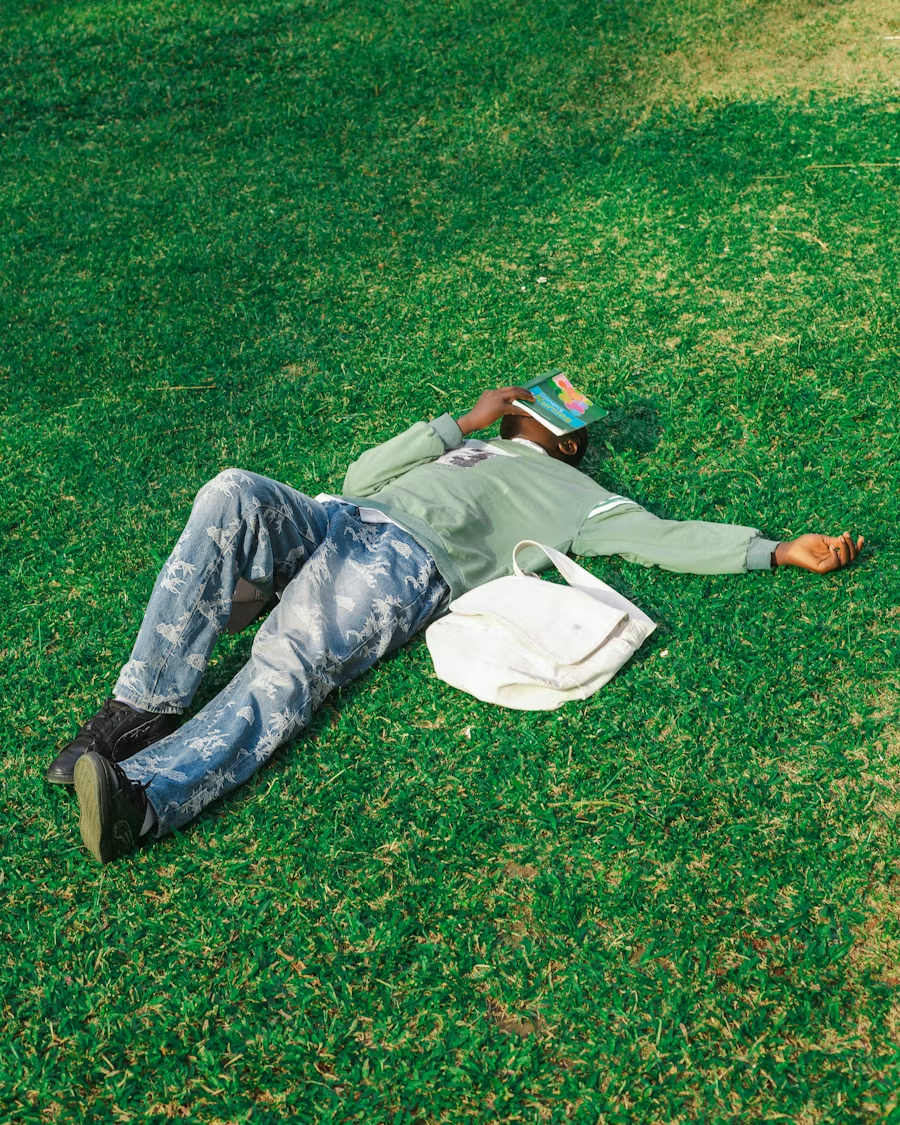
Summer reading used to mean something specific — a book you only had time for because you were somewhere without obligations, a story you read in three days flat because the weather was good and the phone was far away. These twelve books are chosen for exactly that. Some are new, some are decades old, some will take a week and some will take an afternoon. All of them are worth your time before the summer is over.
Rob Delaney — the comedian, the writer, the man you know from Catastrophe — wrote this memoir about the death of his two-year-old son Henry from a brain tumor. That sentence makes it sound like a book you'd have to brace yourself to open. It isn't. It's 200 pages of love so specific and so honest that it works as a document of what a family actually is — the texture of it, the ordinary moments, the way time moves when something is ending. Delaney is funny even here, not because he's deflecting but because humor was how he and Henry and the rest of his family lived. You'll put it down feeling lucky. That's the right way to start a summer. Read this first, before anything else on this list, while the people you love are nearby.
View on Amazon →A middle-aged actress living in New York begins to feel that her husband, her son, and the lodger who has moved into their apartment are somehow strangers — people she has been performing a relationship with rather than actually having one. Kitamura is one of the sharpest writers working right now, and Audition is her best novel: a psychological thriller without a crime, a portrait of a marriage that feels so precise it makes you slightly paranoid about your own. It was shortlisted for the 2025 Booker Prize and should have won. Spare, elegant, unsettling, and impossible to put down.
View on Amazon →The 2025 Booker Prize winner follows an emotionally detached man across decades — from a Hungarian housing estate to the mansions of London's wealthy elite — as a series of events dismantles everything he thought he was. Szalay writes about contemporary masculinity with more precision than anyone working in English right now. The prose is spare to the point of severity, and the novel earns every page of it. Roddy Doyle chaired the judging panel that selected it. If you want to understand what literary fiction is doing right now, this is the book to read.
View on Amazon →An Irish family is falling apart — the father's business is collapsing, the mother is drinking, the teenage daughter is making increasingly dangerous decisions, and the son has retreated into a fantasy world in the woods behind their house. Murray gives each of them their own section, their own voice, their own version of events, and then lets the full picture emerge. It's 650 pages long and reads like 300. Dua Lipa recommended it to her book club earlier this year and described it as Percival at his very best — "delivering one-liners that will make you howl with laughter, while simultaneously punching you in the gut." That's exactly right. One of the best novels of the decade.
View on Amazon →A failed bank robber accidentally takes a group of apartment hunters hostage. The hostages are a collection of people at various stages of falling apart — a divorced couple, an elderly woman, a young couple expecting a child — and over the course of one day in a Stockholm apartment, they become something like a family. Backman is the most reliably moving novelist working in popular fiction right now, and this is his funniest and most structurally inventive book. It sounds like a gimmick. It isn't. If you've been meaning to try Backman and haven't, start here — this is the one that will make you read everything else he's written.
View on Amazon →A letter from a son to his mother, who cannot read. The son — a Vietnamese-American poet growing up in Hartford, Connecticut — writes about his childhood, his grandmother's trauma, the tobacco farm where he worked as a teenager, and the boy he fell in love with there. Vuong is a poet first, and every sentence in this novel earns that description: dense, precise, and so beautiful that you slow down to read passages twice. It's the kind of book that changes the way you pay attention to language for a while after you've finished it. Short enough to read over a weekend, lasting enough that you'll think about it all summer.
View on Amazon →A communist spy is embedded within the South Vietnamese army as it collapses in 1975. He escapes to America with the refugees he has been reporting on, and continues his mission from Los Angeles — watching, reporting, assimilating, performing. Nguyen writes from the perspective of a man who is genuinely two people simultaneously, and the novel's central irony — that the spy sees everything and understands nothing — is one of the great literary conceits of the past twenty years. It won the Pulitzer Prize, was adapted as an HBO series with Robert Downey Jr., and is the kind of book that makes you feel you've understood a piece of history that was previously opaque. Essential summer reading.
View on Amazon →Thirteen linked stories about a retired schoolteacher in a small coastal Maine town — difficult, sharp-tongued, occasionally kind, always watching. Olive appears in each story at a different distance: sometimes at the center, sometimes glimpsed from across a parking lot. The effect is cumulative and devastating. By the end you know her the way you know someone you've lived next door to for twenty years — not completely, but more than you expected. It won the Pulitzer Prize in 2009 and has never gone out of print. The kind of book that feels like summer in New England even if you've never been there — the light, the water, the particular loneliness of small towns in beautiful places.
View on Amazon →Russo's latest novel returns to the small-town northeastern America he has made his own across thirty years of writing. Tyler Sinclair left Stone Mountain as a young man and became a rock star. Now he's back, and the people he left behind have been keeping score. Russo is a master of the kind of fiction where an entire community becomes a character — where the grudges and secrets and loyalties of a small place accumulate into something that feels like fate. Lit Hub called it the ideal summer read, and they're right: it's propulsive, warm, and so filled with precisely observed human beings that you forget you're reading a novel. Out in 2026 and already one of the year's best.
View on Amazon →Thirteen interconnected stories about the music industry, spanning several decades and a cast of characters whose lives keep intersecting in unexpected ways. A record label executive and his assistant are the nominal center, but Egan moves forward and backward in time, in and out of different characters' heads, and at one point delivers an entire chapter as a PowerPoint presentation that is somehow one of the most moving things you'll read this year. It won the Pulitzer Prize and the National Book Critics Circle Award in the same year. If you think you know what a novel is allowed to do structurally, this one will change your mind. The music industry backdrop gives it a specific texture — the ambition, the compromise, the way time takes everyone eventually — that makes it feel like the best album you've ever heard about making albums.
View on Amazon →Everyone reads On the Road. Far fewer people get to The Dharma Bums, and that's a mistake — this is the better summer book. Published in 1958, it follows Kerouac and the poet Gary Snyder (thinly disguised as Japhy Ryder) through a series of mountain climbs, wilderness camps, and Zen conversations that feel more alive and more useful than anything in On the Road. There's a sequence where they climb the Matterhorn in the Sierra Nevada that is one of the great pieces of outdoor writing in American literature. The Buddhist ideas that run through it haven't aged — the lightness, the letting go, the idea that the point of a journey is the walking and not the arriving. The book you want in your bag for a week in the mountains.
View on Amazon →Published in 1958, this is one of the best-selling poetry collections in American history — over a million copies in print, which tells you something about what Ferlinghetti was doing that other poets weren't. He wrote for the speaking voice, for performance, for people standing in the back of City Lights Bookstore in North Beach with a glass of wine. The poems are funny and political and melancholy in rotation, and they hold up completely. "I am waiting for my case to come up" remains one of the great opening lines. Read it last, after everything else on this list, somewhere with good light. Ferlinghetti died in 2021 at 101. He spent his whole life insisting that poetry was for everyone. He was right.
View on Amazon →